






44% reduction in development budget poses serious challenges to reproductive health and human development
Population should be viewed not as a burden but as valuable human capital for national development, says Media Coalition meeting
Lahore (Staff Reporter)
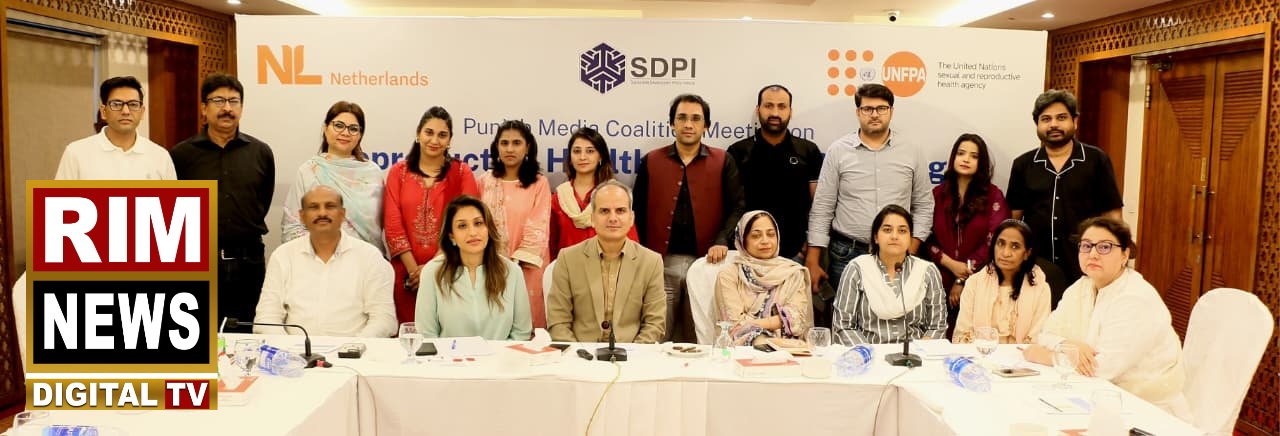
The maternal mortality rate in Punjab has reached 157 deaths per 100,000 live births, while the province’s development budget has been reduced by 44 percent. Journalists, bureau chiefs, and digital media representatives were informed of these alarming statistics during the Fourth UNFPA Media Coalition Meeting, organized by the United Nations Population Fund (UNFPA) in collaboration with the Sustainable Development Policy Institute (SDPI).
The meeting, held with the support of the Government of the Netherlands, was attended by more than two dozen senior journalists and regional media representatives from across Punjab. The objective of the meeting was to promote responsible journalism based on facts and authentic data regarding population, reproductive health, youth, child marriage, gender-based violence, and human development.
During the session, participants were provided with the latest data from the Pakistan Labour Force Survey, the Pakistan Social and Living Standards Measurement Survey (PSLM), and the national census to help them prepare public-interest investigative reports and quality news stories. A practical demonstration was also given on how Artificial Intelligence (AI) can generate potential news headlines from the same datasets on topics including the development budget, family planning, youth unemployment, out-of-school children, child marriage, and maternal mortality.
UNFPA Punjab Coordinator Tanya Durrani stated that the approval of the Punjab Child Marriage Restraint (Amendment) Bill became possible through continuous parliamentary engagement and a study visit to Sindh, during which members of the Punjab Assembly closely examined Sindh’s legislation. She emphasized that the purpose of the Media Coalition is not to direct journalists but to support them professionally by providing information, data, and research material. She assured participants that UNFPA and SDPI would continue providing journalists with concise data sheets, updates on legal developments, and access to relevant experts.
UNFPA Head of Communication and Advocacy Maryam Nawaz said that sensationalism in reporting gender-based violence must be avoided. She expressed concern that, in some cases, attempts are made to obtain details of incidents directly from affected women and underage girls, which is not only unethical but also contrary to the dignity of survivors. She stressed that such reporting should always be guided by the four fundamental principles of consent, protection, dignity, and public interest.
She further stated that reproductive health should not be presented solely from the perspective of population control, as the population should be regarded not as a burden but as valuable human capital for national development. Referring to UNESCO statistics, she said that three out of every four women worldwide experience some form of online violence or harassment, while journalists are also affected by this issue, with many incidents remaining unreported.
Dr. Sajid Amin, Deputy Executive Director (Research) at SDPI, said that the Media Coalition is not merely a formal activity but a serious effort to initiate a sustained national dialogue on sensitive social issues that are still rarely discussed openly in society. He added that journalists are among the most effective agents of social change and urged editors and bureau chiefs to give these issues a permanent place in their editorial priorities.
Husna, UNFPA’s reproductive health specialist, said that although Punjab has legislation regarding pre-marital counseling, its effective and uniform implementation remains a major challenge. She explained that UNFPA has trained religious scholars in this regard and introduced pre-marital counseling services at certain government health facilities. However, she emphasized that the gap between policy and implementation still needs to be bridged.
At the conclusion of the meeting, Tanya Durrani urged journalists to use the Media Coalition as a permanent platform for knowledge-sharing and research. She assured participants that UNFPA would continue providing journalists with access to legal and technical experts, authentic data, and concise informational material to promote informed, balanced, and responsible reporting on issues related to population, health, education, gender equality, and human development.
The participants reaffirmed their commitment to promoting fact-based, research-driven, and data-supported reporting on important social issues, including family planning, reproductive health, out-of-school children, child marriage, gender equality, and violence against women.