







Revenue from Carbon and Petroleum Levies Reflects Public Contribution to Climate Action; Nearly 70% Cut in Climate Funding Raises Concerns
Islamabad (Staff Reporter)
In view of the growing climate-related threats facing Pakistan’s economy, food security, and financial stability, experts, parliamentarians, and development professionals have urged the government to make climate change a central component of national economic and budgetary planning.
They warned that the nearly 70 percent reduction in allocations for the climate sector in the Federal Budget 2026-27, along with an 84 percent decline in the budget of the Ministry of Climate Change over recent years, is deeply concerning.
The speakers emphasized the need for stronger coordination between the federal and provincial governments, effective utilization of climate finance, pre-arranged financial safeguards, mandatory climate reporting, enhanced international partnerships, and the integration of climate risks into financial and economic planning frameworks.
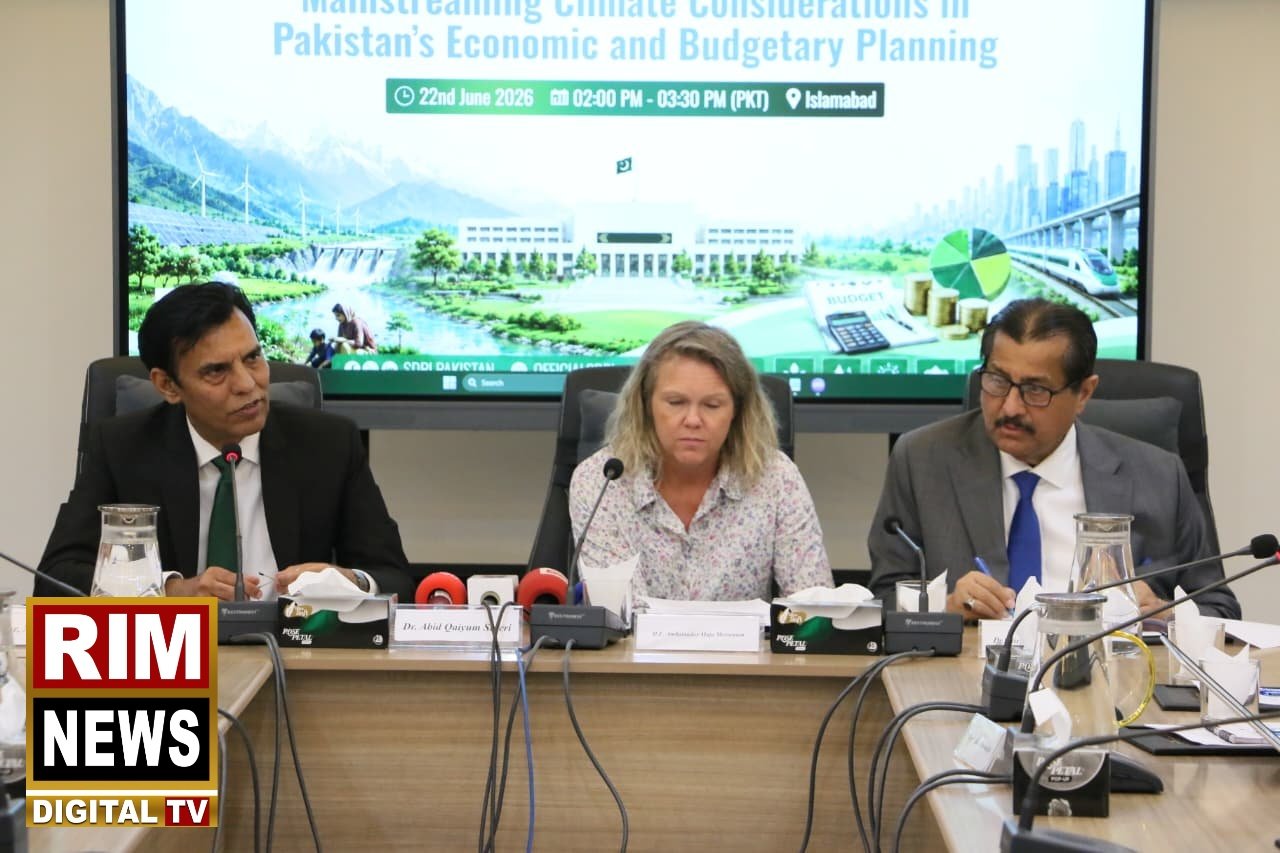
These views were expressed during a parliamentary consultation titled “Mainstreaming Climate Considerations into Pakistan’s Economic and Budget Planning”, organized by the Sustainable Development Policy Institute (SDPI) in collaboration with the Embassy of Denmark.
Speaking on the occasion, SDPI Executive Director Dr. Abid Qaiyum Suleri said that climate considerations should be prominently incorporated into federal and provincial finance bills, particularly at a time when Pakistan’s budget framework is being shaped under the International Monetary Fund’s (IMF) Extended Fund Facility (EFF) and Resilience and Sustainability Facility (RSF) programs.
He noted that reforms supported by the IMF have led to increased allocations for disaster resilience, water conservation, and renewable energy projects. However, he warned that despite escalating climate risks, both international and domestic climate financing are declining, making stronger federal-provincial cooperation essential.
Danish Ambassador to Pakistan Maja Mortensen stated that environmental and climate issues can no longer be treated as isolated concerns and must instead be integrated into economic and political policymaking. She emphasized that the challenge has already been identified, and the real task now is translating it into practical policies. She also offered Denmark’s experience and technical cooperation in this regard.
Pakistan Peoples Party Member of the National Assembly and member of the National Assembly Standing Committee on Economic Affairs, Mirza Ikhtiar Baig, said that despite contributing only a minimal share to global emissions, Pakistan remains among the countries most severely affected by climate change. He expressed disappointment over the failure of the international community to fulfill reconstruction commitments made after the devastating floods of 2022.
He added that revenue generated through carbon and petroleum levies demonstrates that ordinary citizens are also contributing to efforts aimed at combating climate change.
PPP MNA Asad Alam Niazi stated that climate change has now become a national security issue, but public awareness regarding its economic and social impacts remains inadequate. Linking population growth with climate resilience, he noted that Pakistan will need to create millions of new jobs annually by 2050 while simultaneously addressing climate threats, food insecurity, and child malnutrition.
Head of SDPI’s Energy Unit, Engineer Ubaid-ur-Rehman Zia, emphasized that incorporating climate considerations into financial and economic planning has become an urgent necessity. He said Pakistan should strengthen its climate diplomacy and capitalize on global partnerships to secure climate finance and advance sustainable development.
SDPI’s Head of Environment and Circular Economy, Zainab Naeem, presented key findings on climate budgeting, revealing that allocations for the climate sector in the Federal Budget 2026-27 have declined by nearly 70 percent compared to the previous year.
She recommended the establishment of climate financial buffers, mandatory climate impact reporting, financing mechanisms for anticipatory action, and improved integration of climate risks into public financial management.
Former Managing Director of the Private Power and Infrastructure Board (PPIB), Shah Jahan Mirza, urged regulatory institutions, including SECP and NEPRA, to develop comprehensive guidelines on climate-related risks.
SDPI Deputy Executive Director (Research), Dr. Sajid Amin Javed, stated that climate change is currently causing annual global economic losses equivalent to approximately 1.53 percent of global GDP. He warned that if adaptation and mitigation measures are delayed, these economic losses could multiply significantly in the coming years.
He concluded that climate change should not be viewed merely as a separate budgetary category but rather as a fundamental pillar of financial and economic planning, as employment, poverty, inequality, food security, and economic growth are now directly linked to climate resilience.