

Committee Urges Greater Women’s Economic Participation, Legal Recognition for Care Workers, and Expansion of Daycare Facilities; Expresses Concern Over Absence of Federal Secretaries
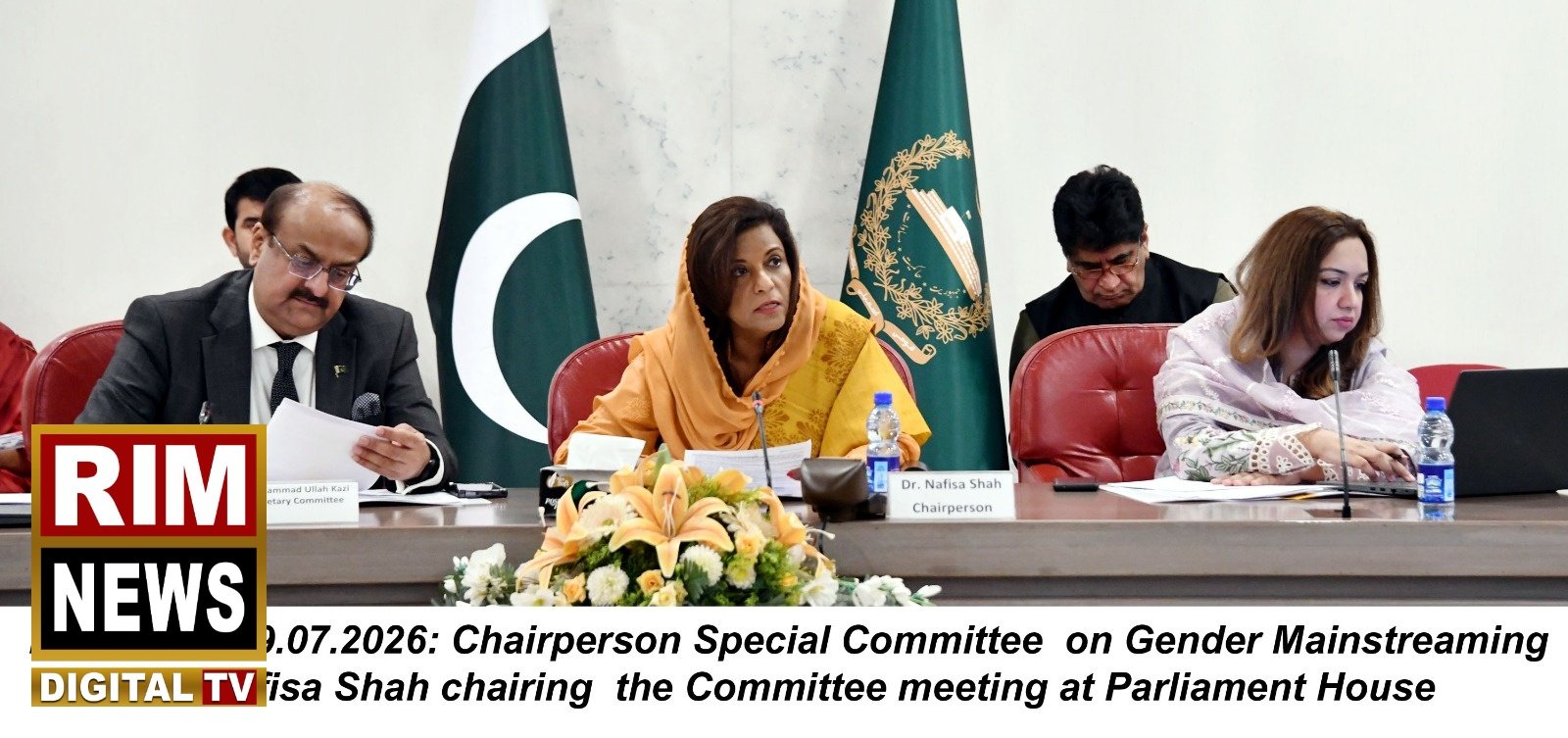
Islamabad (Izhar Khan Niazi): A meeting of the National Assembly’s Special Committee on Gender Mainstreaming was held at Parliament House under the chairpersonship of Dr. Nafisa Shah to review women’s participation in Pakistan’s labor force, the care economy, unpaid care work, and measures to increase women’s participation in the formal economy.
During the meeting, the Pakistan Bureau of Statistics, the Ministry of Overseas Pakistanis and Human Resource Development, and other relevant institutions presented briefings on women’s economic participation, government initiatives, the importance of the care economy, and policy reforms. However, the committee rejected the briefings, terming their quality, statistical data, research methodology, and policy analysis unsatisfactory.
The committee expressed strong displeasure over the absence of the Federal Secretaries of the Ministry of Overseas Pakistanis and Human Resource Development, the Ministry of Human Rights, and the Ministry of Planning, Development and Special Initiatives. It emphasized that the personal participation of senior leadership is essential on matters of national importance and that representation by junior officers does not fulfill the requirements of parliamentary oversight.
The meeting also held detailed discussions on unpaid domestic work performed by women, care work, women’s contributions to the agricultural sector, the protection of domestic workers, the shortage of daycare centers, the legal status of care workers, registration mechanisms, and exploitation in the informal sector.
The committee was informed that, according to the Pakistan Gender Pay Gap Report 2025, women’s average monthly wages are 30 percent lower than men’s, while their average hourly wages are 25 percent lower. The Ministry of Overseas Pakistanis and Human Resource Development informed the committee that the government is taking measures in line with International Labour Organization (ILO) conventions to eliminate gender-based wage discrimination. It further stated that various initiatives are being implemented under the Decent Work Country Programme (2023–2027) and the Global Accelerator on Jobs and Social Protection.
The meeting also received a briefing on measures relating to safe overseas employment opportunities for women. It was informed that the minimum age requirement for women seeking overseas employment as domestic workers has been reduced from 35 years to 25 years in order to expand access to safe and formal employment opportunities.
The committee recommended that the Industrial Relations Act, 2012 be reviewed to grant legal recognition to care workers, that a comprehensive registration system for domestic workers be introduced, that a Care Worker Scorecard be developed, and that the establishment of daycare centers be expanded across the country.
The committee directed the Ministry of Human Rights to prepare a comprehensive inter-ministerial policy briefing on the care economy. It also instructed the Pakistan Bureau of Statistics to clarify its statistical data and research methodology, the Ministry of Overseas Pakistanis and Human Resource Development to present practical proposals for the training and overseas employment of women care workers, and the Planning Commission to recognize the care economy as a formal economic sector and develop a national policy framework.
At the conclusion of the meeting, the committee formally rejected the briefings presented by the Pakistan Bureau of Statistics and the Ministry of Overseas Pakistanis and Human Resource Development. Further deliberations on the matter were deferred until the next meeting. The committee directed the relevant Federal Secretaries to personally attend the next session with a comprehensive policy framework and complete preparations, warning that parliamentary action could be initiated in case of non-compliance. The minutes of the committee’s previous meetings were also confirmed.