






Ensuring financial resources with the transfer of powers is essential; bringing the government closer to the people should be a fundamental goal.
Smaller administrative units can bring the government closer to the public, speakers expressed during a dialogue organized by the Sustainable Development Policy Institute (SDPI).
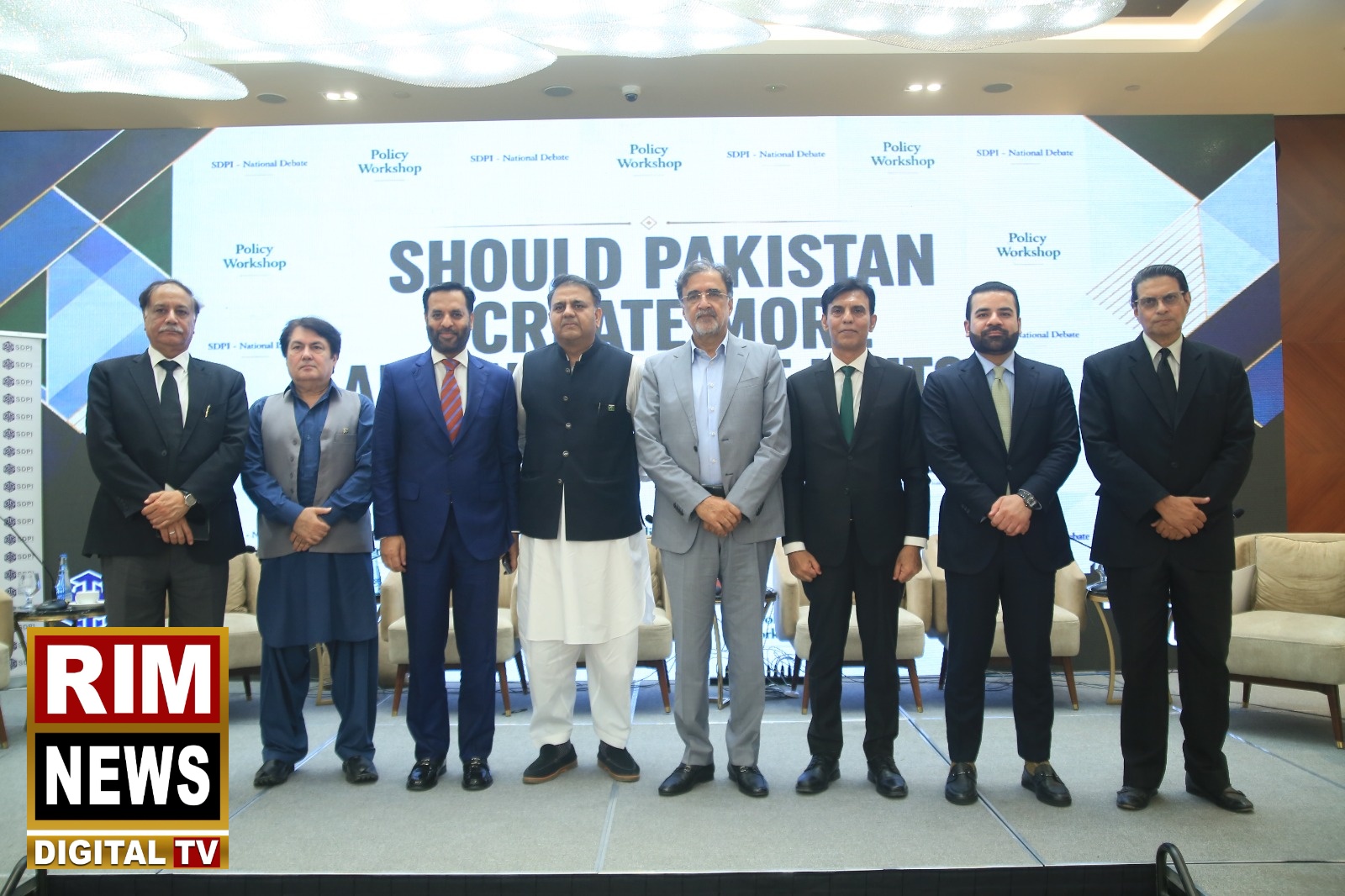
Islamabad (Staff Reporter) – Any change in the administrative map should not merely aim at defining new boundaries but should provide better governance, effective representation, and easy access to basic facilities for the public. This was stated by speakers at a high-level national dialogue on the topic “Should Pakistan establish more administrative units?” organized by the SDPI. Political leaders, policymakers, experts, technocrats, and representatives of civil society discussed various ways to improve governance and public service delivery in Pakistan. Participants also agreed on the need to make constitutional requirements, public support, financial sustainability, and administrative capacity the basic criteria for providing better governance, effective representation, and easy access to basic facilities. Different opinions were presented regarding the appropriate governance structure and the size of administrative units. During the dialogue, some participants supported the establishment of new provinces or smaller administrative units, while others emphasized further empowering various levels of the existing system. Most participants believed that both paths should be viewed as part of a comprehensive reform process rather than alternatives to each other. Federal Minister for National Health, Regulations, and Coordination Syed Mustafa Kamal stated that any change in the administrative structure should fundamentally be assessed on whether it reduces feelings of deprivation and exclusion among the public and provides them with better services. He mentioned that smaller administrative units can bring the government closer to the people; however, regardless of the number of provinces, empowered local governments will remain an essential part of effective governance. He stated that proposals for new provinces should have public support. Minister of State for Law and Justice Barrister Aqeel Malik pointed out the lack of financial resources in meaningful power transfer and suggested that national, provincial, and local elections be held simultaneously with a uniform term. He also emphasized the need to constitutionally protect local bodies from being dissolved before their term. Parliamentary Secretary for Information and Broadcasting Barrister Daniyal Chaudhry stated that the issue of new provinces should be advanced based on the constitution and evidence. He also stressed the need to transfer political, administrative, and financial powers to the grassroots level. Pakistan Peoples Party leader and former Federal Minister for Information Qamar Zaman Kaira noted that the discussion on changing the administrative structure is not new. However, the reform process should proceed with caution to avoid increasing inter-provincial or regional sensitivities regarding resource distribution. PPP leader and former Member of National Assembly Nadeem Afzal Chan stated that political and state institutions should jointly formulate a consensus-based reform agenda. He identified judicial and electoral reforms, democratic processes within political parties, and the rule of law as important areas linked to governance improvement, stating that any proposal for changing the administrative structure should remain within the constitutional framework. Jamaat-e-Islami’s Deputy Amir Liaqat Baloch emphasized that the establishment of new provinces and strengthening local governments should be considered alongside broader financial and constitutional reforms. He stressed the need for a more effective role of the Council of Common Interests in resolving disputes between the federation and provinces over resources, water, and other constitutional matters. Former Federal Minister Asad Umar identified declining public trust in state institutions and excessive centralization as major governance issues in Pakistan. He proposed a three-tier NFC system. He stated that where there is a strong public desire for new provinces, it should be considered; however, the economic benefits and drawbacks of larger or smaller provinces should be determined based on evidence rather than conjecture. Former Mayor of Lahore Mian Amir Mehmood supported evidence-based consideration for the establishment of new provinces, stating that the primary goal should not merely be regional division but ensuring public welfare and easy access to government services. He emphasized the need for more effective accountability of elected representatives, strengthening political parties, and further transferring powers from provinces to lower levels. The Prime Minister’s Assistant for Trade Rana Ehsan Afzal stated that the discussion should not be limited to the number of provinces but should connect to the broader question of vertical power transfer and financially autonomous, continuously functioning, and empowered local governments. Pakistan Tehreek-e-Insaf Secretary General Salman Akram Raja noted that an administrative structure already exists at the division, district, and tehsil levels in Pakistan; even if Punjab is divided into three provinces, each new province would still be larger in population than most European countries. He emphasized the need to clearly define the constitutional, administrative, political, and financial powers of local governments and to provide strong constitutional protection for the provincial financial commission system. According to him, the process of changing provincial boundaries should follow the procedure outlined in Article 239 of the constitution. MQM Pakistan leader and Member of National Assembly Asiya Ishaq supported the establishment of smaller provinces for effective administration. She stressed the need for a strong local government system with powers clearly defined under Article 140-A of the constitution. Member of National Assembly and former Chairman of the Public Accounts Committee Noor Alam Khan stated that comprehensive governance reforms are necessary before and alongside the establishment of new provinces. He clarified that full compliance with Article 239 of the constitution regarding the establishment of provinces and the constitutional requirement of a two-thirds majority in Parliament is essential. Economic expert and political analyst Dr. Farakh Saleem opposed the creation of a large number of new provinces, stating that institutional weaknesses must be addressed first. He noted that Pakistan’s fundamental issue is not merely tax collection but also government spending and the quality of governance. Senior journalist and analyst Muhammad Malik stated that merely changing the administrative structure will not be effective without changes in institutional behavior and political culture. He noted that Pakistan fundamentally faces a crisis of institutional capacity that cannot be resolved simply by establishing new administrative units. Former Federal Minister Fawad Chaudhry stated that political consensus is necessary for any change in the administrative structure rather than unilateral decisions. He suggested that in the event of provincial division, the names of existing provinces should be retained to preserve identity while creating room for transferring administrative powers to lower levels. Prominent supporter of the establishment of a Seraiki province, Zahoor Dhareja, stated that establishing a new province is essential to address governance, representation, employment, and identity issues faced by the region. He noted that a separate province would create opportunities for government jobs and educational institutions through specific quotas, helping to reduce long-standing developmental deprivation. Former Federal Minister and former advisor to the Chief Minister of Khyber Pakhtunkhwa Barrister Muhammad Ali Saif stated that broad political consensus is necessary before any progress towards new provinces, as without it, the legal and political status of such measures could become contentious. He suggested establishing a national commission comprising representation from Parliament and all political parties, which would formulate recommendations on the matter after consulting all relevant stakeholders. In closing remarks, SDPI Executive Director Dr. Abid Qayyum Suleri emphasized that the national dialogue highlighted the importance of discussing various governance models and reform proposals within a single policy forum. He stated that while participants presented different opinions on new provinces and administrative units, there was significant agreement on the importance of effective local governments, meaningful transfer of financial powers, and better public service delivery as key components of any future governance system. He noted that this dialogue succeeded in bringing forth important points for further consideration, research, and evidence-based policymaking rather than finalizing a single structural solution. The dialogue also featured remarks from Dr. Khakan Hassan Najeeb, former advisor to the Ministry of Finance, Muhammad Ali Durrani, former Federal Minister, and Haroon Rashid, President of the Supreme Court Bar Association, among other speakers.