





By Areeba Younis
Date: 14 August 2026
Master’s Programme, School of Economics and Management,
Yanshan University, Qinhuangdao City, Hebei Province, China.
Artificial Intelligence (AI) is quickly changing how organizations manage people at work. What was once a traditional Human Resource Management (HRM) system focused mainly on hiring, salaries, and employee records is now becoming more digital, data-driven, and intelligent.
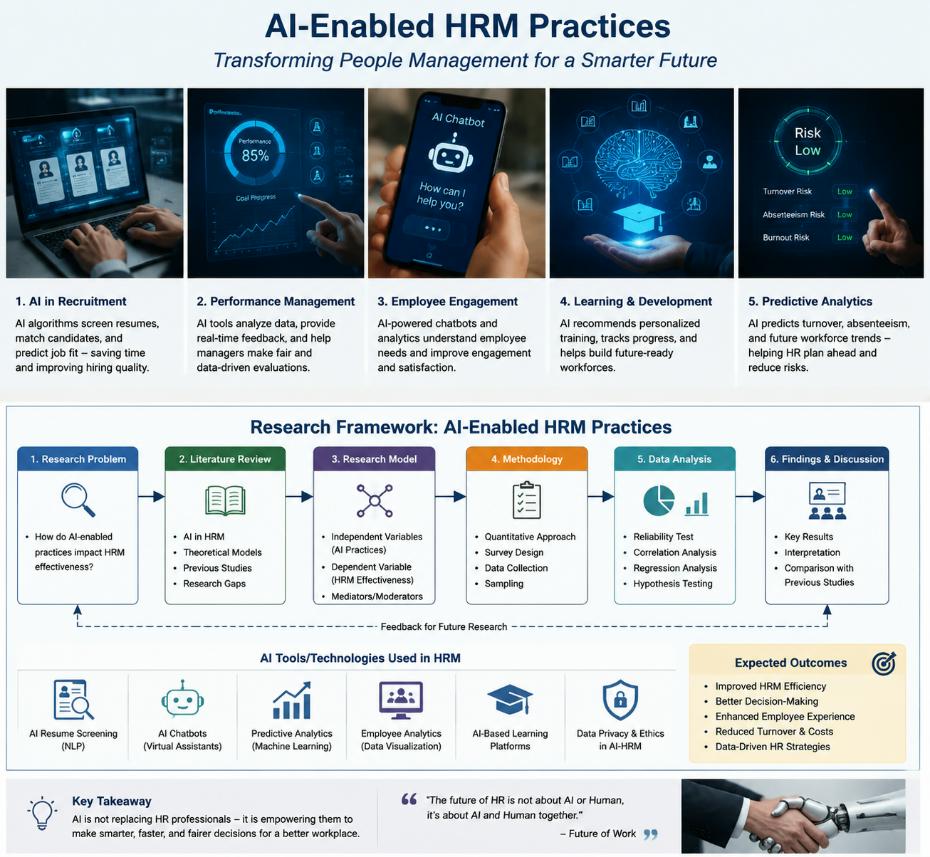
Today, companies are using AI tools to support HR decisions in areas such as recruitment, performance management, employee engagement, and training. These tools help organizations work faster, reduce errors, and make better decisions based on data rather than only human judgment.
In recent years, AI has become an important part of modern HRM practices across different industries. From automatically shortlisting job applicants to predicting employee turnover and analyzing workforce behavior, AI is helping HR professionals understand employees in a more efficient way. It is also improving communication, reducing workload, and supporting better planning in organizations.
However, AI in HRM is not only about technology. It is also about balance. While AI systems can process large amounts of information quickly, human understanding is still important in areas like motivation, emotions, fairness, and workplace relationships.
This article explores how AI is being used in Human Resource Management practices, how it is changing traditional HR roles, and what opportunities and challenges it creates for organizations and employees in today’s digital world.
I never thought I would end up studying Artificial Intelligence in Human Resource Management. A few years ago, HR to me simply meant hiring people, managing payroll, and handling office issues. But today, as an MBA student at Yanshan University in China, I find myself exploring how AI is quietly reshaping the way organizations manage people.
My journey into this topic did not start in a lab or a classroom. It started with curiosity.
When I first heard about AI in HRM, I honestly thought it was something far away—robots replacing humans, automated systems taking over decision-making, and complicated algorithms that only tech experts could understand. But as I began my MBA studies, I realized AI in HR is not about replacing humans. It is about supporting them.
That realization changed everything for me.
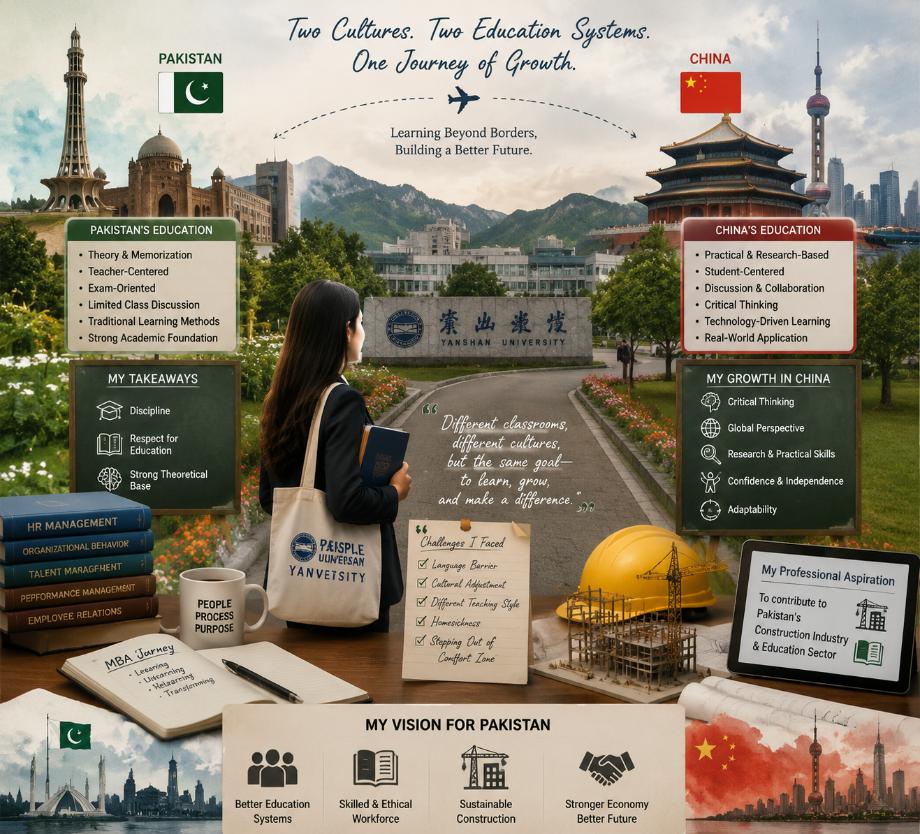
Coming from Pakistan and studying in China has already been a learning experience on its own. The academic environment here is structured, fast-moving, and research-focused. At Yanshan University, I was encouraged to think beyond textbooks and explore real-world problems. That is where my interest in AI-enabled HRM practices started to grow.
But like any research journey, it was not smooth at the beginning.
One of my biggest challenges was understanding how AI actually fits into human resource practices. Concepts like predictive hiring, automated performance evaluation, and AI-based employee engagement sounded impressive—but also confusing. I spent hours reading research papers, comparing studies, and trying to connect theory with real workplace situations.
Slowly, things started to make sense.
I began to see how organizations use AI to make HR processes faster and more accurate. For example, AI can help filter job applications, analyze employee performance trends, and even predict employee turnover. What once felt like science fiction now felt like something happening in real offices around the world.
But the more I learned, the more questions I had.
Can AI truly understand human behavior? Can a machine measure motivation, loyalty, or emotional stress? And most importantly, where do we draw the line between human judgment and machine decisions?
These questions became the heart of my research.
Another important part of my journey has been working with data. As part of my research, I explored real survey responses related to AI adoption in HR practices. At first, data felt overwhelming. Numbers, variables, and patterns all looked confusing. But gradually, I started enjoying the process of finding meaning behind the data.
Every dataset felt like a story about real workplaces—how employees feel about technology, how managers use digital tools, and how organizations are adapting to change.
Beyond technical challenges, there was also a personal learning curve.
Being an international student in China means constantly adapting—new systems, new teaching styles, and new expectations. But this environment also pushed me to become more independent in my thinking. I learned how to question, analyze, and build arguments instead of simply accepting information.
One of the most interesting parts of my research journey has been realizing that HR is no longer just about people—it is about people and technology working together.
AI does not remove the human element; it enhances it when used correctly. It helps HR professionals make better decisions, save time, and focus more on employee well-being instead of repetitive tasks.
At the same time, I also learned that technology is not perfect. There are concerns about bias in AI systems, privacy issues, and over-reliance on machines. These challenges made me realize that the future of HRM will depend on balance—not choosing between humans or AI, but combining both wisely.
Outside research, my daily life as a student also shaped my thinking. Discussions with classmates from different countries helped me understand how organizations operate in different cultural contexts. These conversations often made me rethink my own assumptions and improve my understanding of global HR practices.
Looking back, my journey into AI-enabled HRM has been more than an academic requirement. It has been a process of learning how technology and humanity interact in modern workplaces.
I started with curiosity, moved through confusion, and slowly developed clarity. I am still learning, still questioning, and still exploring.
But one thing is certain—AI is not just the future of HRM. It is already part of it. And as a student and researcher, I feel I am standing right in the middle of this transformation, trying to understand where humans end and technology begins—and how both can work better together.