




Women’s Role Essential for National Development and Sustainable Peace: Minister of State for Interior
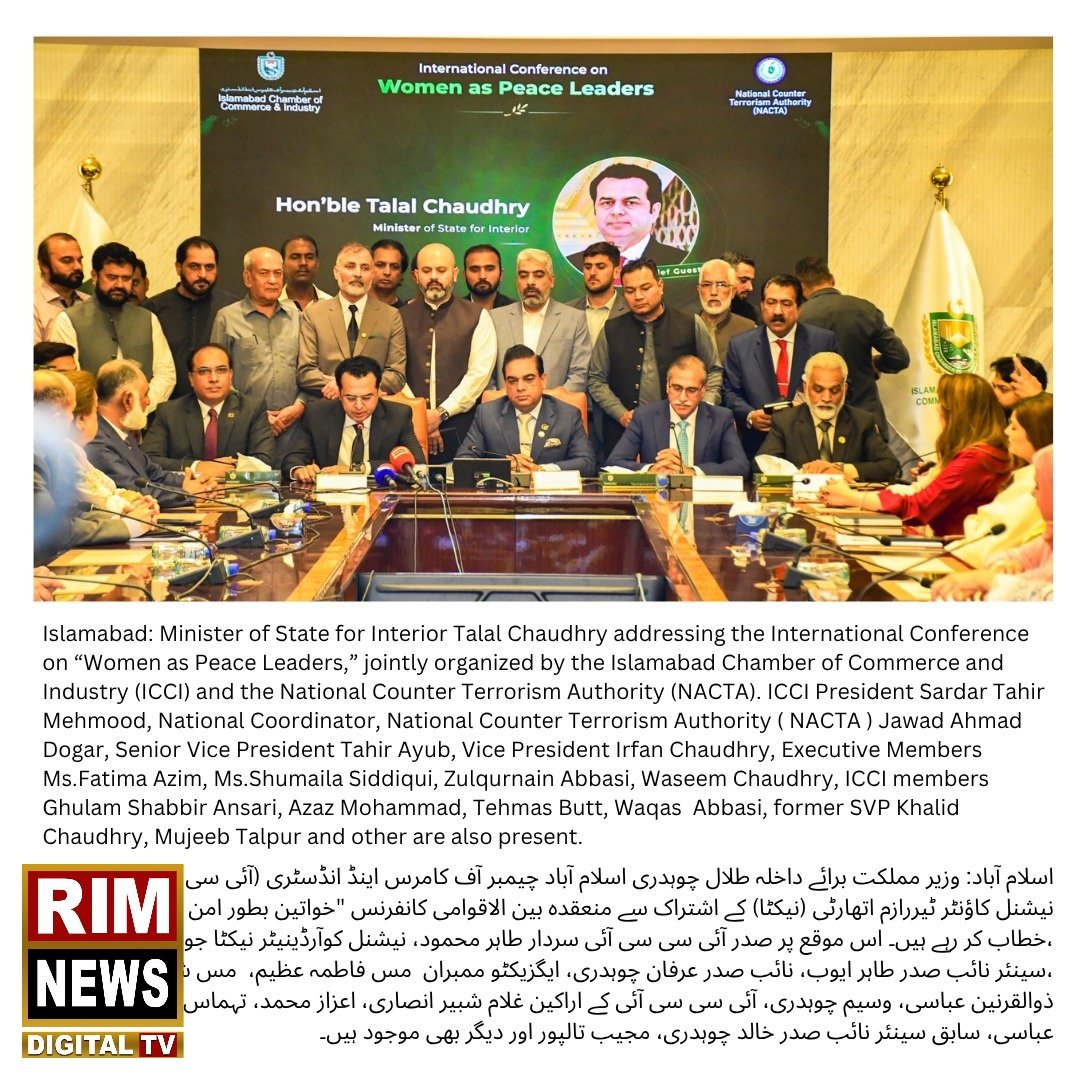
Islamabad (Special Correspondent) – Minister of State for Interior, Talal Chaudhry, has said that the Government of Pakistan is committed to empowering women and ensuring their meaningful participation in every sphere of national life. He stated that women’s empowerment is indispensable for national development, economic growth, social harmony, and the establishment of sustainable peace.
He expressed these views while addressing the international conference titled “Women as Peace Leaders,” jointly organized by Islamabad Chamber of Commerce and Industry (ICCI) and National Counter Terrorism Authority (NACTA). The conference brought together policymakers, security experts, academics, diplomats, business leaders, civil society representatives, and international delegates to discuss the role of women in promoting peace, countering extremism, and strengthening national stability.
Talal Chaudhry stated that Pakistan’s National Security Policy recognizes gender security as an important component of national security and emphasizes the need for a comprehensive and inclusive strategy for peace and development. He said that the vision is to build a Pakistan where every girl has access to education, every woman benefits from leadership opportunities, and every citizen can contribute to the country’s bright future. He added that women’s empowerment is not merely a social objective but a national necessity.
Speaking on the occasion, Sardar Tahir Mahmood, President of ICCI, said that women are not merely beneficiaries of peace but are also its architects, advocates, and guardians. He stated that women play a vital role as educators, entrepreneurs, policymakers, community leaders, and peacebuilders in promoting tolerance, social harmony, and national development.
He further said that ICCI is undertaking various initiatives to promote women’s entrepreneurship, employment, leadership, and economic empowerment. According to him, peace and economic prosperity are closely linked, and empowering women is essential for building a stable, strong, and prosperous Pakistan.
National Coordinator NACTA, Javad Ahmed Dogar, said in his address that preventing violent extremism is a shared global responsibility that requires international cooperation and evidence-based policymaking. He noted that Pakistan’s counterterrorism experience has demonstrated that security measures alone are insufficient for achieving lasting peace. It is equally important to address the ideological, social, digital, and structural factors that give rise to extremism. He expressed hope that the conference recommendations would contribute to future policymaking and research.
Former Lieutenant General Nigar Johar, Hilal-i-Imtiaz (Military), stated that the effects of conflict, terrorism, and violence disproportionately impact women. She said that women often bear the greatest burden as victims, caregivers, widows, and guardians of future generations. She emphasized that women are natural advocates of peace and therefore should be effectively represented in decision-making, negotiations, and peace processes. Referring to the global Women, Peace and Security agenda, she said that sustainable peace and security cannot be achieved without women’s participation at every level of leadership and governance.
Dean of the Faculty of Contemporary Studies at National Defence University, Dr Arshi Saleem Hashmi, stated that women’s issues should not be viewed solely through a domestic lens but within a broader social and developmental context. She said that women are not only affected by conflicts but also play an effective and strategic role in conflict prevention, community resilience, and peacebuilding. She stressed the need for stronger policy measures and institutional support to increase women’s participation in leadership, governance, and security sectors across South Asia.
Panel discussions during the conference also featured contributions from Dr Bushra Mirza, Saima Rahim, Dr Noor Amna Malik, Dr Noor Fatima, Naqba Mumtaz Qazi, Dr Humeira Shafie, Nadia Tariq, Prof Dr Rubina Hanif, and Saima Ahsan.
The event was attended by ICCI Senior Vice President Tahir Ayub, Vice President Irfan Chaudhry, Executive Members Fatima Azeem, Shamaila Siddiqui, Wasim Chaudhry, Zulqarnain Abbasi, Imran Minhas, former Senior Vice President Khalid Chaudhry, ICCI Standing Committee on Higher Education Convener Adnan Mukhtar, as well as a large number of representatives from the business community, educational institutions, civil society, and various other sectors of society.