







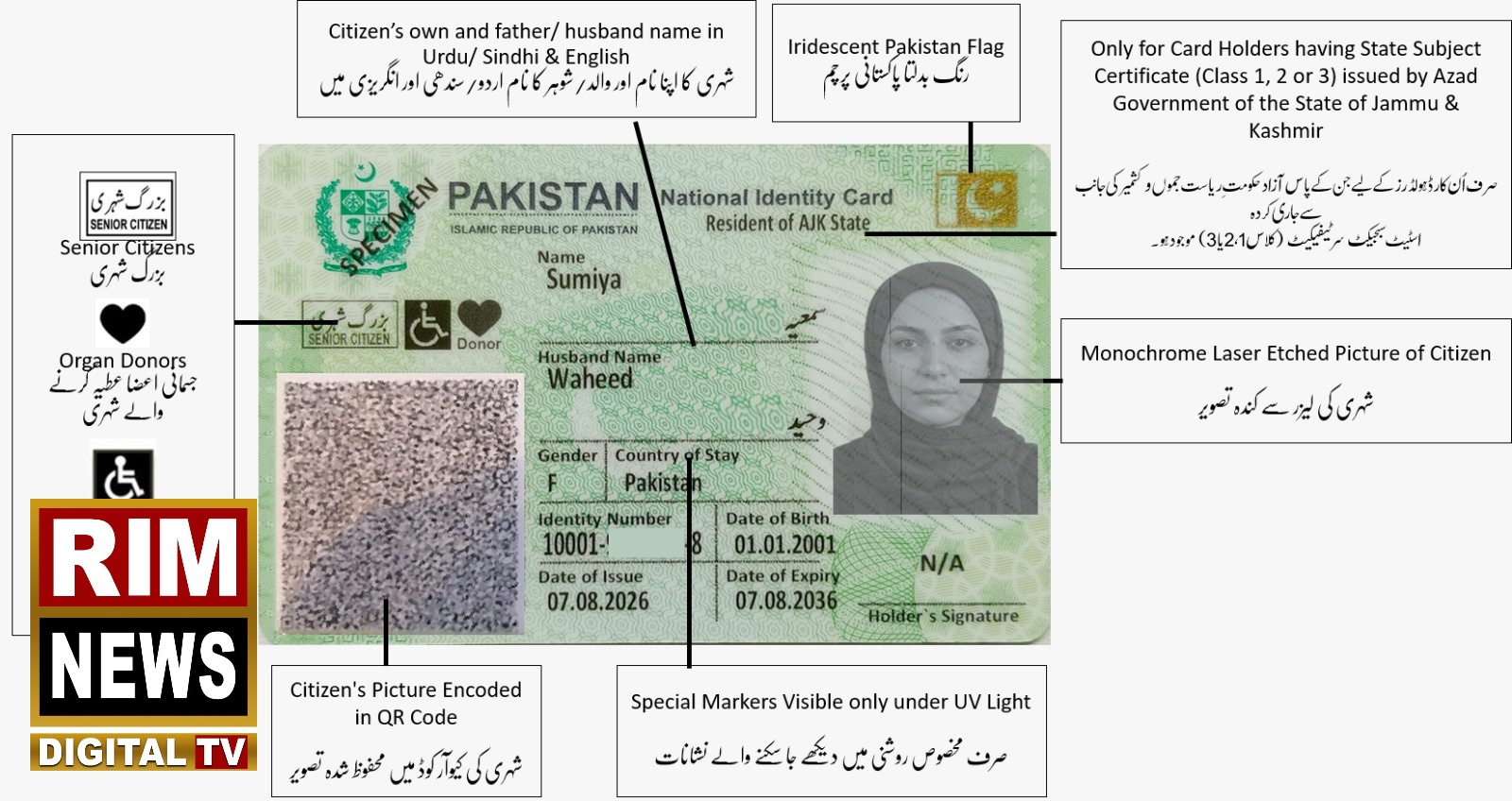
Islamabad (Staff Reporter) In a significant advancement towards self-reliance and more accessible digital identity verification, the National Database and Registration Authority (NADRA) has introduced a new chipless national identity card featuring a secure QR code. This polycarbonate card has been produced in Pakistan by the National Security Printing Company (NSPC) in Karachi, adhering to NADRA’s technical and security requirements. The use of a secure QR code eliminates reliance on imported microchips, while also making secure digital verification easier and more efficient.
The federal government approved the issuance of the new card on February 23, 2026. The new card replaces the microchip with a secure QR code, which can be read and verified on smartphones through the Pak Identity (PakID) mobile application. The QR code will contain the cardholder’s relevant identification information and photograph. This will enable various institutions to enter names, addresses, and other required identification details into their computerized systems more easily and uniformly, reducing errors during data entry.
The new card will also feature specific markings for disabled individuals, senior citizens, organ donors, and residents of the state of Azad Jammu and Kashmir, along with a family number. The cardholder’s name and address will be displayed in both Urdu and English. The visible and hidden security features of the card have also been modernized in accordance with current requirements and the manufacturing capabilities available in the country.
The chip-based smart national identity card was introduced nearly 14 years ago. However, due to the lack of available chip readers and related infrastructure, the facilities associated with the chip could not be utilized as intended. The new QR code-based card addresses this practical barrier, as its verification can be done using any standard smartphone or camera with appropriate software. Telecom operators, banks, hospitals, Pakistan Railways, police, and other authorized institutions will also be provided with software to read and verify the QR code on the card.
The new card will be introduced in phases. In the first phase, starting August 14, 2026, the new polycarbonate card with the QR code will be issued to replace the currently issued plain Teslin material national identity cards, which are chipless. From January 2027, the same new card will also be issued for all types of national identity cards, including the National Identity Card for Overseas Pakistanis (NICOP) and juvenile cards. In the final phase, the Pakistan Origin Card (POC) will also be transitioned to the new QR code-based card without a chip.
All previously issued types of identity cards will remain valid until their specified expiration dates.