



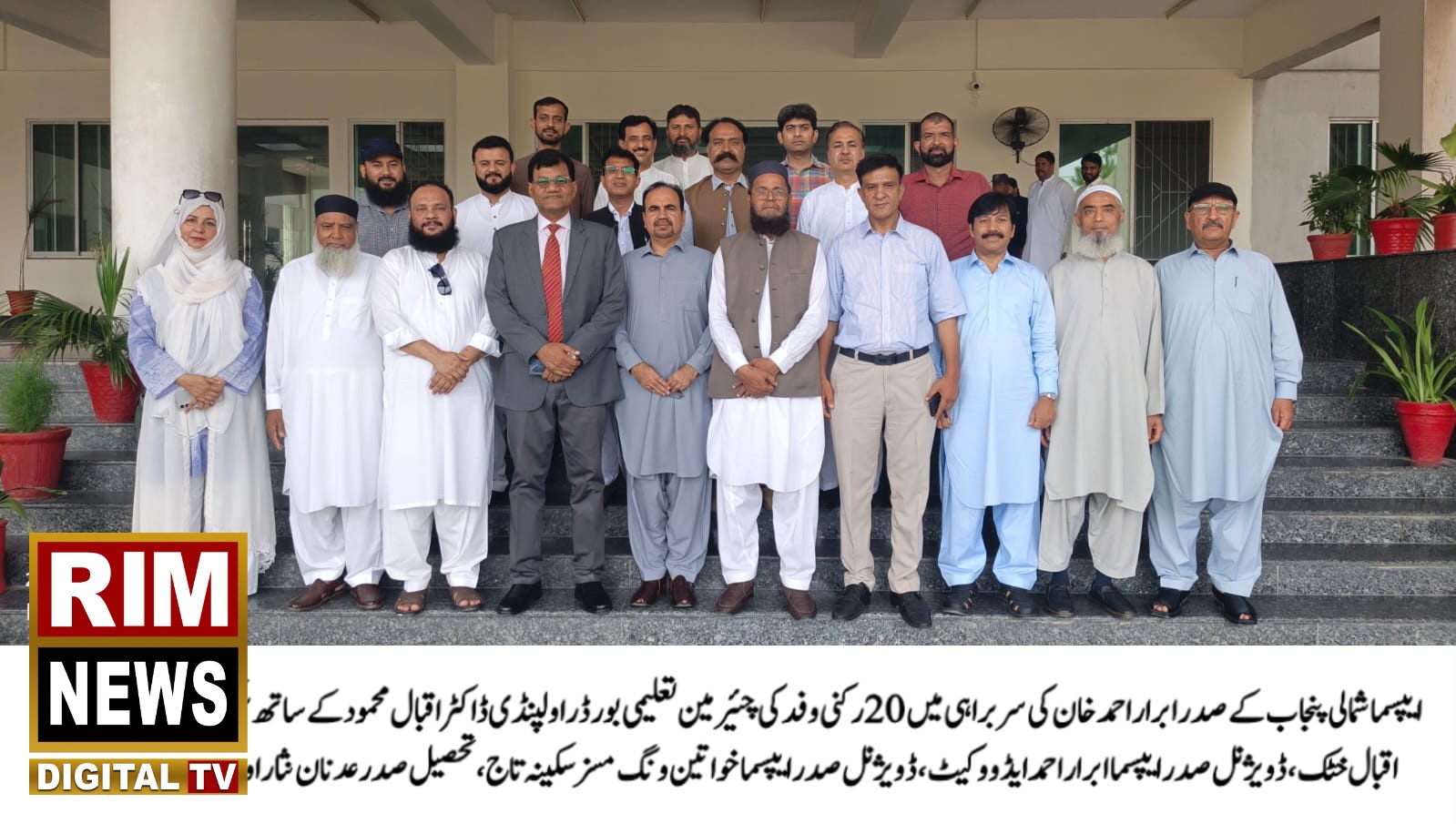
APPSMA Northern Punjab Delegation Meets Chairman of Rawalpindi Board of Intermediate and Secondary Education; Both Sides Agree to Strengthen Mutual Cooperation
Rawalpindi (News Reporter): A 20-member delegation of the All Pakistan Private Schools Management Association (APPSMA) Northern Punjab, led by its President Abrar Ahmad Khan, met Dr. Iqbal Mahmood, Chairman of the Board of Intermediate and Secondary Education (BISE) Rawalpindi, at his office. The delegation congratulated him on his appointment as Chairman and extended their best wishes.
The meeting was attended by Secretary BISE Rawalpindi Amjad Iqbal Khattak, APPSMA Divisional President Abrar Ahmad Advocate, Women’s Wing Divisional President Mrs. Sakina Taj, Rawalpindi Tehsil President Adnan Nisar, Divisional Finance Secretary Kamran Saif Qureshi, Tariq Mahmood, Raja Asif, Mateen Ahmad, Shiraz Mughal, Sheikh Nadeem, Muhammad Kamran, Rehan Abbasi, Sarfraz Ahmad, Anwar-ul-Haq, and other association leaders. Mahboob Ahmad, Personal Secretary to the Chairman, and Arslan Ali Cheema, Spokesperson for BISE Rawalpindi, were also present.
Speaking on the occasion, Abrar Ahmad Khan said that private educational institutions play a fundamental role in promoting education, increasing literacy, and providing quality education across Pakistan. He stated that the private education sector is a strong partner of the government and an important stakeholder in the national education system. Therefore, he emphasized that the private sector should be consulted and adequately represented in educational policymaking and administrative affairs. He also assured the Board of APPSMA’s full cooperation.
Chairman Dr. Iqbal Mahmood said that the role of the private education sector is undeniable. He remarked that without private educational institutions, it would not be possible to bear the burden of the country’s and the province’s education system. He noted that individuals associated with private institutions provide education to the nation’s children through their personal investment, financial risk, and tireless efforts, describing it as a great national service.
He further said that adopting a facilitative and positive approach toward educational institutions, students, and parents is the need of the hour. He emphasized that the contributions of private educational institutions cannot be measured solely in financial terms, as they are an invaluable asset to the nation’s development and progress.
During the meeting, the participants also held detailed discussions on making the education system more effective, improving the examination system, providing better facilities to students, promoting cooperation between public and private educational institutions, and strengthening mutual coordination.
The meeting concluded in a cordial atmosphere, with both sides expressing their commitment to continue cooperation and consultation for the promotion of quality education, the improvement of the education system, and a brighter future for students.