




Shakeel Khurshid’s poetry is commendable for its impact and sincerity of expression: Dr. Nasir Mahmood
His poetry presents a beautiful blend of thought, emotion, and expression: Prof. Dr. Muhammad Saleem Mazhar
Islamabad (Special Correspondent)
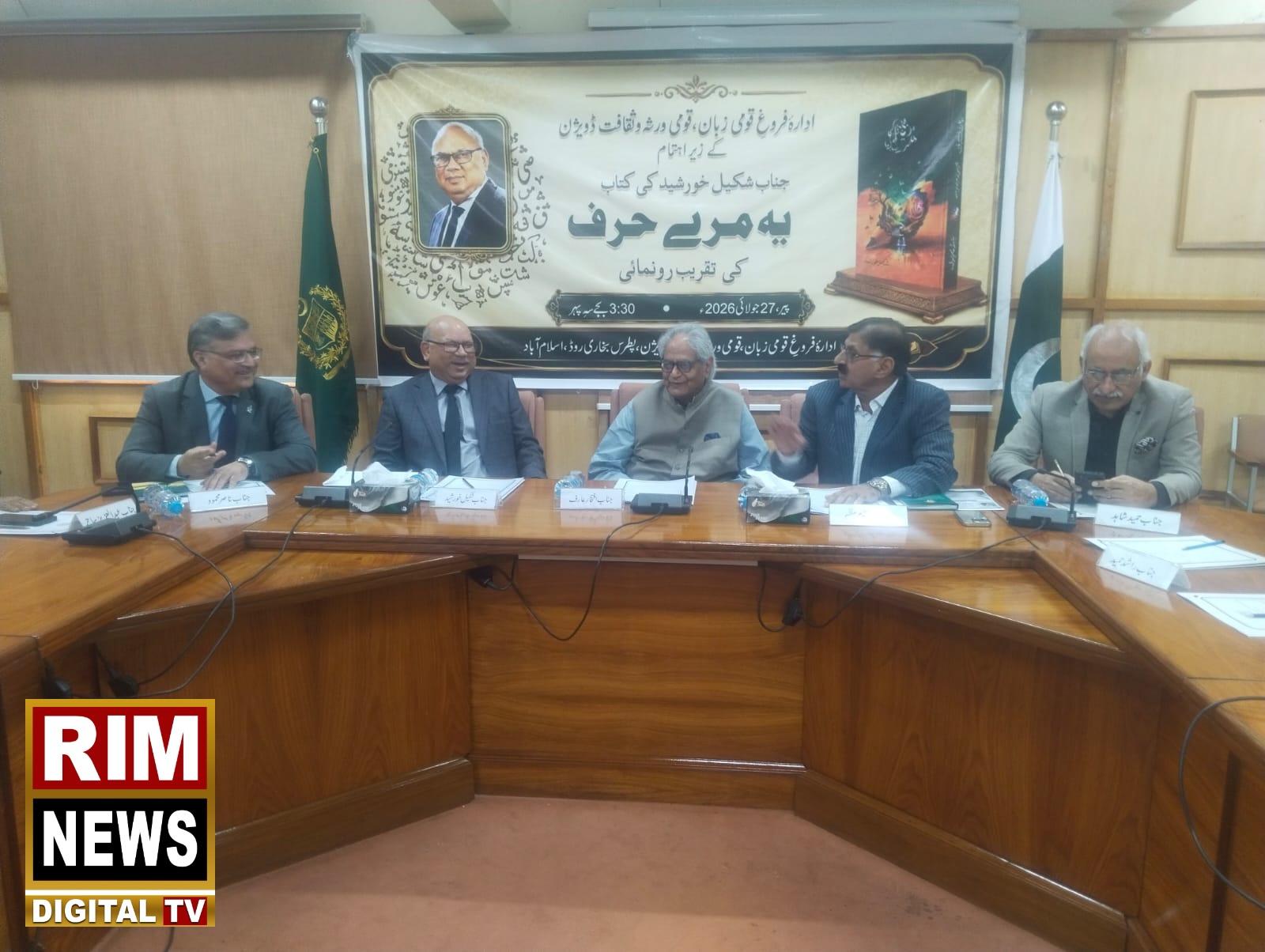
The National Language Promotion Department, under the National Heritage and Culture Division, organized the book launch ceremony of renowned poet Shakeel Khurshid’s poetry collection, “Yeh Mere Harf” (These Are My Words), at Dr. Ishtiaq Hussain Qureshi Hall.
The ceremony was presided over by eminent poet and scholar Iftikhar Arif, while Prof. Dr. Muhammad Saleem Mazhar, Director General of the National Language Promotion Department, and Prof. Dr. Nasir Mahmood, Vice Chancellor of Allama Iqbal Open University, attended as chief guests.
Among those who expressed their views were distinguished scholar, fiction writer, and critic Muhammad Hameed Shahid, former Dean of the Faculty at Allama Iqbal Open University Dr. Abdul Aziz Sahir, Mamoon Tahir Rana, Head of the Urdu Department at Allama Iqbal Open University Dr. Arshad Mahmood Nashad, and young poet Farzand Ali Hashmi. The event was hosted by Dr. Mehnaz Anjum.
At the beginning of the ceremony, Dr. Rashid Hameed, Executive Director of the National Language Promotion Department, welcomed the guests and said that Shakeel Khurshid’s poetry possesses both simplicity and sweetness. He remarked that during his 26-year career in the Pakistan Air Force, Shakeel Khurshid surprised everyone by producing such beautiful poetry.
Presiding over the event, Iftikhar Arif said that a poet’s first book is like a first love, and “Yeh Mere Harf” reflects Shakeel Khurshid’s intellectual insight, literary awareness, and profound command of language. He stated that such publications are a valuable addition to the intellectual treasure of Urdu literature and play an important role in connecting the younger generation with quality literary works.
He further remarked that just as Saadat Hasan Manto and Muhammad Hameed Shahid cannot be measured by the same standard, similarly Shakeel Khurshid should not be judged by the standards of Allama Iqbal, Hafiz, or Ferdowsi.
Chief Guest Prof. Dr. Muhammad Saleem Mazhar, Director General of the National Language Promotion Department, said that Shakeel Khurshid’s writings present a beautiful combination of thought, emotion, and expression. He added that a person brought up in a literary environment—whether an engineer or a mathematician—will naturally express himself through poetry. He said that Shakeel has portrayed both his past and present beautifully and simply in his verses.
He also stated that the literary activities of the National Language Promotion Department are making significant contributions to the promotion of Urdu language and literature and that the institution remains fully committed to serving Urdu.
Chief Guest Prof. Dr. Nasir Mahmood, Vice Chancellor of Allama Iqbal Open University, Islamabad, said in his address that seeing Shakeel Khurshid as a poet is a unique experience. He praised the impact and sincerity of his poetry and remarked that, in his very first creative publication, Shakeel Khurshid has demonstrated remarkable poetic skill and expressed his emotions with confidence and honesty.
Muhammad Hameed Shahid said that Shakeel Khurshid has presented social emotions and human experiences in a highly effective manner through his poetry. He observed that this collection introduces readers to new dimensions of reflection and thought.
He further said that the temperament of any poet can be understood from the opening verses of his ghazals, and that Shakeel’s ghazals naturally exhibit inner depth, rhythm, and fluency. He noted that Shakeel neither believes in unnecessary complexity nor excessive simplicity, but instead uses everyday language. The softness of his tone, he added, enhances the beauty of his poetry.
Dr. Abdul Aziz Sahir said that “Yeh Mere Harf” is evidence of the poet’s deep commitment to literature and creative dedication. He remarked that in one ghazal, Shakeel Khurshid has successfully combined Hamd (praise of Allah), Naat (praise of the Holy Prophet ﷺ), and Manqabat (poetry in praise of saints or revered personalities), describing it as a successful and innovative literary experiment. He added that such books further strengthen the tradition of Urdu literature.
He also noted that while slang is commonly used in fiction, Shakeel has, for the first time, employed it effectively and elegantly in poetry. According to him, the poet has also revived several words that have largely disappeared from contemporary ghazals.
Dr. Arshad Mahmood Nashad, Head of the Urdu Department at Allama Iqbal Open University, Islamabad, said that the work presents a beautiful combination of contemporary awareness and literary aesthetics. He expressed confidence that Shakeel Khurshid’s contribution would prove to be a significant addition to Urdu literature.
He further observed that silence appears almost as a character in Shakeel’s poetry and that the remarkable quality of the verses in his very first book reflects his high standing as a poet.
Poet and writer Mamoon Tahir Rana, who had traveled from Multan, said that Shakeel Khurshid’s poetry is distinguished by its simplicity, fluency, and intellectual depth. He stated that the book would be highly appreciated in literary circles because it comes from the heart and reaches the hearts of its readers.
Young poet Farzand Ali Hashmi remarked that “Yeh Mere Harf” is not merely the story of Shakeel Khurshid’s words but a testimony to his inner emotions and experiences. He said that the poet appears to engage in a deeper dialogue with his inner self than with the external world.
At the conclusion of the ceremony, Shakeel Khurshid recited selected verses from his poetry and received warm appreciation from the audience. A large number of scholars, writers, and literary enthusiasts attended the event and described the launch of the book as a welcome development for Urdu literature.
The successful event concluded with congratulations extended to the poet, followed by tea served to all participants.