


Struggle Against Land Grabbing, Forced Evictions, Economic Exploitation and State Repression Will Continue
Islamabad (City Reporter) – Political parties, civil society organizations, intellectuals, lawyers, and citizen representatives have rejected the federal budget, describing it as anti-people, and warned that increasing economic exploitation, forced evictions, and restrictions on civil liberties are causing the majority of working people to become increasingly alienated from the state.
They stated that working-class communities across the country are being deprived of their homes, lands, and means of livelihood. From the recent evictions of residents of informal settlements in Islamabad and rural communities to the grabbing of agricultural lands, ordinary citizens continue to face economic and social pressures. They further alleged that institutions responsible for safeguarding fundamental rights, including Parliament and the higher judiciary, have largely come under the influence of powerful groups and profit-driven interests.
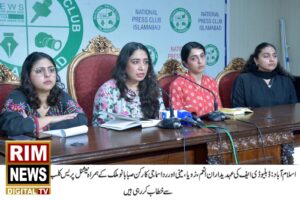
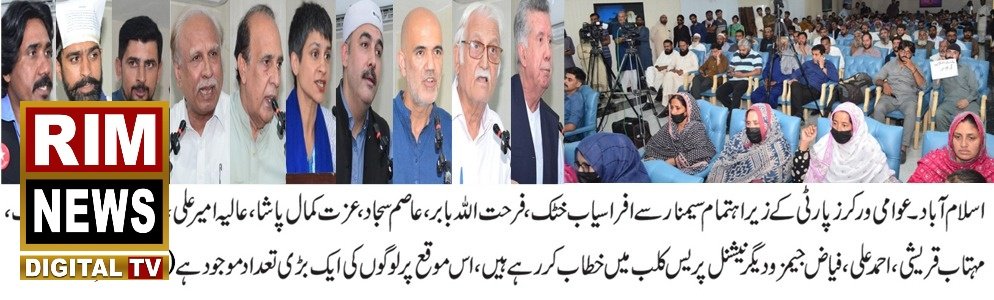
The speakers expressed these views while addressing a seminar organized by Awami Workers Party Marxist at the National Press Club Islamabad.
More than two hundred individuals from various social, political, and public sectors participated in the seminar. Prominent speakers included Asim Sajjad Akhtar, Farhatullah Babar, Akbar Zaidi, Afrasiab Khattak, Ayesha Shahid, Izzat Kamal Pasha, Alia Ameer Ali, Tariq Usmani, Umar Gilani, and Shakeel Jalil.
The speakers said that working classes in the country are being deprived of their homes, lands, and sources of livelihood. From the recent evictions of residents of Islamabad’s informal settlements and rural communities to the occupation of agricultural lands, ordinary citizens are continuously facing economic and social pressures. According to them, this situation has further weakened the already fragile social contract between the state and the people.
The speakers stated that Pakistan’s political and economic structure, inherited from the colonial era, has become increasingly oppressive over time. They said that new forms of economic exploitation include pressure arising from loans provided by international financial institutions, the growing influence of the urban real estate mafia, and the concentration of wealth through the misuse of authority by state officials, all of which are backed by state coercion.
They maintained that whenever ordinary people resist in order to protect their informal settlements, agricultural lands, and fundamental rights, they face the power of the state. They further alleged that institutions responsible for protecting fundamental rights, including Parliament and the higher judiciary, have largely come under the influence of powerful circles and profit-seeking classes.
Participants also expressed concern that the continuous failure to meet the housing needs of low-income groups has led to an increase in informal settlements in Islamabad. However, these settlements are declared illegal and targeted, while large housing schemes and controversial land acquisitions continue to receive official patronage.
The speakers stated that the policies of the Capital Development Authority (CDA) reflect discriminatory treatment against poor and vulnerable sections of society. Actions against street vendors and small business owners, confiscation of goods, and restrictions on employment opportunities are part of the same approach.
The seminar also expressed concern regarding the situation of Islamabad’s historic villages, including Saidpur, Malpur, Mohalla Noori Bagh, Noor Pur Shahan, Bari Imam Sarkar, and Dhoke Tahli, as well as the environmental damage affecting these areas. According to the speakers, deforestation and unplanned construction have severely impacted the local environment and air quality.
The participants also reaffirmed their commitment to continue the struggle against land grabbing, forced evictions, economic exploitation, and state repression in Islamabad and throughout the country, and to intensify efforts aimed at uniting all pro-people and democratic forces on a common platform.