







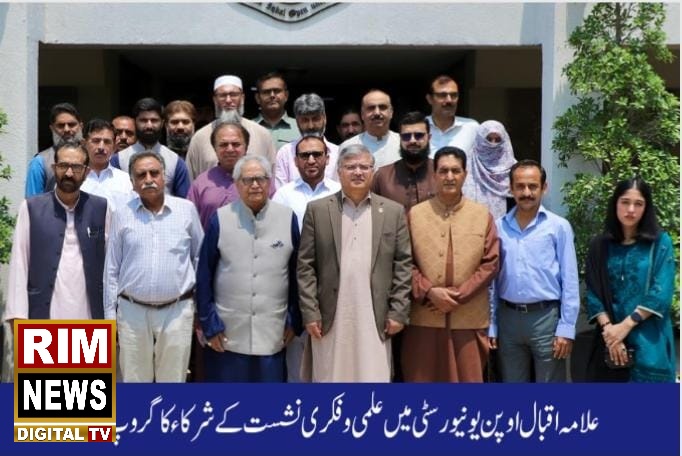
Allama Iqbal’s Intellectual Vision, Poetic Depth, and Insight on Ahl al-Bayt (A.S.) and the Tragedy of Karbala Are Unparalleled: Iftikhar Arif
Islamabad (Staff Reporter): A prestigious academic and intellectual session was held at Allama Iqbal Open University as part of the celebrations marking the 150th birth anniversary of the Poet of the East, Allama Muhammad Iqbal. Renowned poet, writer, and intellectual Iftikhar Arif delivered the keynote address. The event was presided over by Vice Chancellor Professor Dr. Nasir Mahmood, while Professor Dr. Abdul Aziz Sahir, Executive Director of the Iqbal Chair and Sufi Thought, hosted the ceremony.
In his presidential address, Vice Chancellor Professor Dr. Nasir Mahmood said that the message of Allama Muhammad Iqbal continues to serve as a beacon of intellectual, moral, and spiritual guidance for the younger generation. He stated that Allama Iqbal Open University, in keeping with its association with Iqbal’s name and philosophy, considers the promotion of Iqbal’s thought to be one of its academic, national, and cultural responsibilities. He added that the university has consistently been organizing academic and research activities to advance this objective.
He reaffirmed the university’s commitment to continue promoting Iqbal’s philosophy through academic dialogue, research initiatives, and intellectual activities aimed at strengthening the nation’s intellectual tradition.
Speaking on the theme “Haqeeqat-e-Abadi Hai Maqam-e-Shabbiri” (The Eternal Reality Is the Station of Shabbiri), Iftikhar Arif said that Allama Iqbal presented the tragedy of Karbala as an enduring symbol of truth, justice, freedom, liberty, and resistance against oppression. He said that the great sacrifices of Imam Hussain (R.A.) and the Ahl al-Bayt (A.S.) stand as a declaration that everything—including one’s life, wealth, family, and all that is dear—can be sacrificed for the supremacy of truth, but one should never submit to falsehood, oppression, or tyranny.
Iftikhar Arif further said that in the entire tradition of Urdu and Persian poetry, there are very few examples comparable to the breadth of vision, intellectual depth, and poetic grandeur with which Allama Iqbal expressed his thoughts on the Ahl al-Bayt (A.S.) and the tragedy of Karbala.
He urged young people not to confine Iqbal’s philosophy merely to academic study but to incorporate it into their practical lives, character, education, and national responsibilities so that a society built on integrity, awareness, self-respect, and progress can be established.
On the occasion, Professor Dr. Abdul Aziz Sahir, Executive Director of the Iqbal Chair and Sufi Thought, announced the launch of a unique project to produce an audio recording of “Kulliyat-e-Iqbal” in the voice of Iftikhar Arif. He said that the initiative would not only help preserve Iqbal’s poetry but would also make a significant contribution to research, teaching, and the promotion of intellectual discourse.