






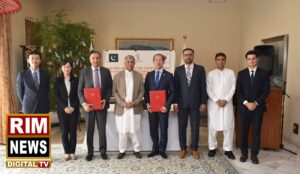

Agreement reached to cooperate in population, research and policy-making; both institutions to collaborate on evidence-based research and training
Dr. Abid Qayyum Suleri stresses effective implementation of MoU; Aslam Ghori terms partnership important for national planning
Islamabad (Staff Reporter): Dr. Abid Qayyum Suleri, Executive Director of the Sustainable Development Policy Institute (SDPI), has said that memorandums of understanding (MoUs) should not remain merely formal documents but should be transformed into practical cooperation, joint research and effective policy initiatives.
He stressed that genuine partnerships between institutions could help the country address complex challenges related to population, development and policy-making.
He expressed these views while addressing a signing ceremony of a memorandum of understanding between the National Institute of Population Studies, Training and Research (NIPST&R) and the Sustainable Development Policy Institute (SDPI). Federal Secretary Ministry of National Health Services, Regulations and Coordination Aslam Ghori was the chief guest at the ceremony.
The MoU was signed by SDPI Executive Director Dr. Abid Qayyum Suleri and Executive Director NIPST&R Mrs. Samina A. Hassan.
Under the agreement, both institutions will jointly work in areas including population planning, demographic research, policy analysis, training, evidence-based research and sustainable development.
Addressing the ceremony, Dr. Abid Qayyum Suleri said the real success of any MoU does not lie in signing the document but in its effective implementation. He said the desired outcomes could not be achieved unless the teams of both institutions considered it a shared responsibility and worked with dedication and professionalism.
He said both institutions now had an excellent opportunity to identify areas of mutual interest with renewed commitment and a clear strategy and promote research that could play an effective role in national policy-making.
Dr. Suleri said planning in sectors such as economy, development, energy, housing and social welfare largely depends on accurately determining per capita requirements. He added that this was where the role of NIPST&R became highly important.
He said NIPST&R could guide various government institutions through authentic population data and research evidence, making national planning more realistic and effective.
Dr. Suleri thanked the Ministry of National Health Services, Regulations and Coordination, saying that the ministry’s cooperation had played a vital role in SDPI’s internationally recognised achievements in combating tobacco use. He said recognition from the World Health Organization reflected the strength of this partnership.
Federal Secretary Ministry of National Health Services Aslam Ghori, in his address, said the cooperation between the two institutions was timely and welcome, as Pakistan was currently facing important challenges including rapid population growth, reproductive health issues and demographic changes.
He said NIPST&R had extensive experience in national demographic surveys and research studies, while SDPI was a recognised institution in policy research, analysis, programme development and public awareness. He said joint efforts by both institutions would not only promote quality research but also provide stronger foundations for national policy-making.
He emphasised that special attention should be given to disadvantaged segments of society lacking basic facilities. Aslam Ghori clarified that research data would not be shared with any third party without prior consent of both institutions.
Earlier, NIPST&R Executive Director Mrs. Samina A. Hassan welcomed the guests and said that under the guidance of the Federal Secretary, effective cooperation between institutions had been strengthened.
She said her institution was currently successfully working on several important projects, including national demographic surveys, five phases of performance monitoring surveys in Punjab, district-level population estimates and a two-year training programme for family welfare workers.
She said SDPI was among the country’s leading policy research institutions and had earned a prominent position at national and international levels. She added that this partnership would provide a new direction to research related to population, development and a sustainable future.
At the conclusion of the ceremony, participants were also shown an introductory documentary film highlighting SDPI’s research, policy and development activities.