

A Pakistani MBA Student’s Journey of Research, Critical Thinking, and Personal Growth
By Areeba Younis
Master’s Programme, School of Economics and Management,
Yanshan University, Qinhuangdao City, Hebei Province, China.
When I boarded my flight from Pakistan to China, I knew that I was not just travelling for one reason—just to earn a degree. I packed my clothes, books, and a long list of expectations. What I did not know was that the most valuable lessons would not come from textbooks or exams. They would come from everyday life, new experiences, and a completely different way of learning.
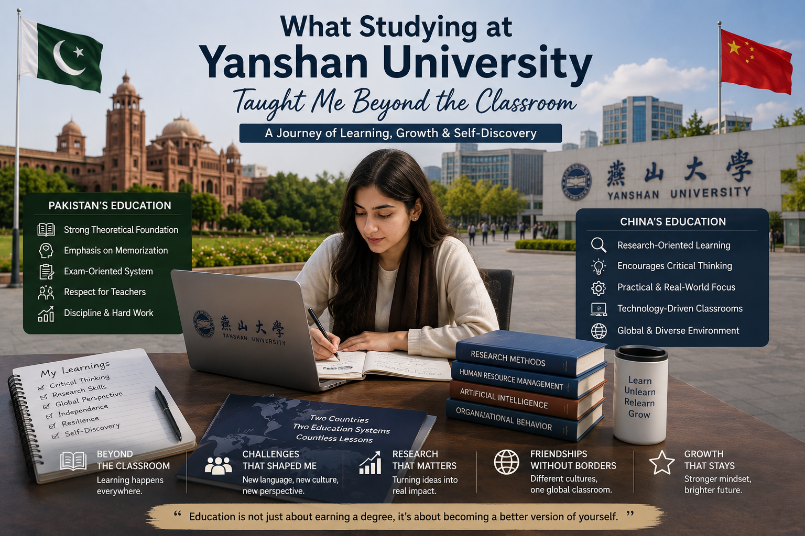
Studying at Yanshan University in Qinhuangdao has changed how I see education, research, and even myself. Like many students in Pakistan, I grew up in a system where academic success was often measured by examination results. We worked hard, attended lectures, took notes, and prepared for exams. The focus was usually on learning the correct answers and performing well in assessments. This approach gave me a solid academic foundation and taught me discipline, but I rarely questioned whether there could be another way to learn.
That question found its answer in China. During my first few weeks at Yanshan University, I quickly realized that the classroom was very different from what I had experienced before. Students were encouraged to ask questions, discuss ideas, and even challenge different viewpoints respectfully. Instead of expecting us to memorize information, professors wanted us to understand it, analyze it, and apply it to real-life situations.
At first, this was uncomfortable, I remember sitting quietly during class discussions, carefully listening while other students confidently shared their opinions. I worried that my ideas might not be good enough or that I would make mistakes. But my professors encouraged participation rather than perfection. Slowly, I found the confidence to speak, ask questions, and contribute to discussions.
That small change made a big difference. One of the biggest surprises was the importance given to research. In Pakistan, I had completed research projects before, but at Yanshan University, research became part of everyday learning. Whether we were discussing management, economics, or technology, we were expected to support our ideas with evidence from academic journals and reliable sources.
As an MBA student researching Artificial Intelligence (AI) in Human Resource Management, I spent countless hours reading international studies, exploring databases, and analyzing data. There were moments when I felt completely overwhelmed. Academic papers were full of unfamiliar theories and technical language, and I often wondered if I had chosen a topic that was too difficult, but every challenge became an opportunity to learn.
With the guidance of my professors, I slowly learned how to identify research gaps, evaluate different viewpoints, and develop my own ideas. Instead of simply accepting information, I began asking why something worked, whether there was a better solution, and how research could solve real business problems. Perhaps the greatest lesson I learned was that education is not about knowing everything it is about learning how to keep learning.
Technology also plays a much bigger role in education here. From digital libraries and online learning platforms to research databases and classroom technology, everything is designed to make learning more accessible. Finding international research articles, communicating with professors, and submitting assignments online soon became part of my daily routine. Outside the classroom, education continued in different ways.
Living in China taught me independence. Simple daily tasks, such as shopping, travelling, or ordering food, became learning experiences because of the language barrier. At first, these situations felt stressful. Over time, they became opportunities to build confidence, patience, and problem-solving skills.
Studying alongside classmates from different countries also changed my perspective. Every group discussion introduced me to new ideas, different cultures, and alternative ways of thinking. I realized there is rarely only one correct answer to a problem. People see the world differently because of their experiences, and listening to those perspectives is one of the best forms of education.
This experience has also made me appreciate Pakistan’s education system in new ways. The discipline, respect for teachers, and strong theoretical foundation I developed back home have helped me succeed in my postgraduate studies. At the same time, studying in China has shown me the value of research, critical thinking, creativity, and practical application.
Rather than asking which education system is better, I now believe both have strengths. Pakistan provides students with determination and strong academic fundamentals, while China’s universities place greater emphasis on innovation, research, and solving real-world challenges. Imagine the possibilities if students could benefit from both approaches.
Looking back, I realize that my MBA journey has never been just about earning a degree. It has been about becoming a more curious learner, a more confident researcher, and a more open-minded person. Yanshan University has taught me lessons that no examination could measure. It has shown me that education is not limited to classrooms, libraries, or research papers. It is found in conversations with classmates, in overcoming challenges, in adapting to a new culture, and in learning to think differently.
When I eventually return to Pakistan, I will bring home more than an MBA. I will carry new ideas, new perspectives, and a deeper understanding of what education can truly be. And perhaps that is the greatest lesson of all: the best universities do not simply teach students what to think they teach them how to think.